

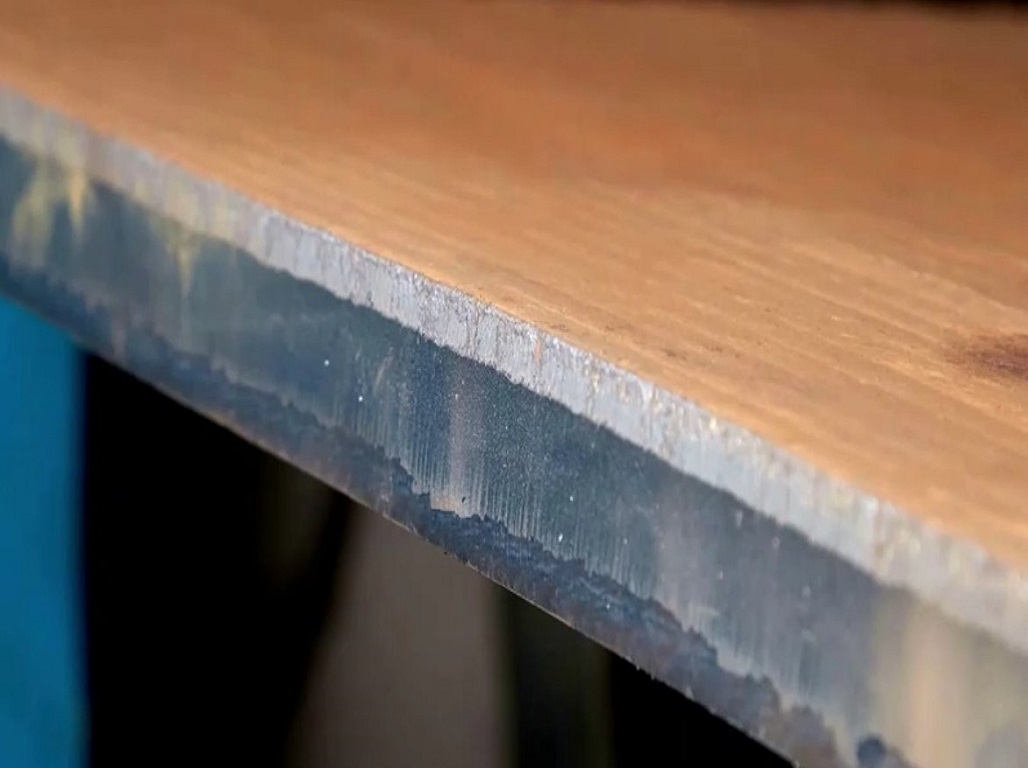
Wear-resistant bimetallic plates RTP.
RTP bimetallic plates are two-layer metal sheets consisting of a layer of low-carbon or heat-resistant steel and a wear-resistant deposited layer.
In bimetallic plates, the main layer and the deposited layer have different functions. The main layer accepts mechanical loads, the deposited layer has high wear resistance and performs a protective function.
The thickness of the base and the deposited layer can be different, depending on the requirements and technical task of the customer.
RTP bimetallic plates are welded with powder tapes of our own production. The cross-section of the powder strips is 16.5*4mm and 10*3mm (depends on the thickness of the original steel sheet). The filling factor of powder ribbons varies from 55 to 62%, which is almost 2 times higher than the filling factor of powder wires. Therefore, when welding with powder strips, we have the opportunity to achieve the required content of carbon (C) and chromium (Cr) already in the first layer, which ensures a stable microstructure of the deposited metal.
The deposition of a wear-resistant layer with powder tapes also makes it possible to obtain bimetallic plates with significantly improved consumer properties.
The field of application of RTP bimetallic plates.
Bimetallic plates are used in many industries – wherever there is erosion and strong abrasive wear. Application examples – buckets of loading machines, vibratory units, buckets of excavators, bodies of heavy-duty dump trucks, pipelines, mills, crushers, rumble, cyclone catchers, chutes, bunkers, overloading devices, sorting devices, fans, filling devices, sieves, mixers, transport pipes and etc.
A great advantage of bimetallic plates is the possibility of manufacturing finished products from them of almost any shape according to the customer’s drawings, taking into account rolling and bending.
RTP plates can be cut to the required size using plasma, laser or hydroabrasive cutting. When using plasma or laser cutting, the cut must be made from the side of the base layer to prevent the penetration of the molten reinforcing alloy into the base material, which makes welding difficult. When hydro-abrasive cutting of the plate, it should be done from the side of the deposited layer.
On surfaces that need to be protected from wear and tear, parts made of RTP plates are easily mounted by welding or special bolts or studs.
The feasibility of using RTP bimetallic plates:
- the possibility of protecting large surfaces from various types of wear and tear;
- increasing the service life of the equipment by increasing the wear resistance of the protected surface;
- a reduction in the weight of the lining by up to 50%, which affects the increase in the productivity of the equipment;
- reducing the duration of production downtime;
- reduction of costs for special repair teams;
- reduction of maintenance and repair costs;
- reduction of operational costs of equipment maintenance, which entails a reduction in the cost of production;
- simplicity of the installation process of bimetallic plates.
Brands of bimetallic plates RTP.
Brands of bimetallic plates that are serially produced by our company:
| Brand | HRC hardness | Diameter, mm (fraction, μm) |
| RTP 214 | 58-62 | 6+4 8+4 10+5 10+9 12+5 12+9 |
| RTP 179 | 58-62 | 6+4 8+4 10+5 10+9 12+5 12+9 |
RTP 214 is a bimetallic wear-resistant plate.
RTP 214 (HRC 58-62) is a bimetallic wear-resistant plate operating in conditions requiring high wear resistance with moderate shock loads. Due to its technological properties, it is the most popular for use in many industries.
RTP 179 is a bimetallic wear-resistant plate.
RTP 179 (HRC >55) is a bimetallic plate for use in parts and assemblies of equipment operating under high abrasion conditions at high temperatures up to 755 °C with moderate impact loads.
RTP 178 is a bimetallic wear-resistant plate.
RTP 178 (HRC 60-65) is a bimetallic wear-resistant plate with increased resistance to abrasive and erosive wear. The deposited layer of complex carbides is characterized by a high density of solid particles, which allows working in conditions of abrasive and gas-abrasive wear at normal and elevated temperatures.
RTP 180 is a bimetallic wear-resistant plate.
RTP 180 (HRC 58-62) is a bimetallic plate for parts of machines and mechanisms operating under conditions of intensive abrasive and gas-abrasive wear with moderate shock loads.
RTP 111 is a bimetallic wear-resistant plate.
RTP 111 (HRC 50-56) is a bimetallic plate with a welded layer of nickel-carbide-chromium alloy. For parts working under conditions of abrasive and gas-abrasive types of wear, at normal and elevated temperatures.
RTP 101 is a bimetallic wear-resistant plate.
RTP 101 (HRC 50-56) is a bimetallic plate for equipment operating under conditions of intensive abrasive and gas-abrasive wear with moderate shock loads.
Table 2 shows typical and possible ratios of the base and deposited layer in RTP bimetallic plates depending on the thickness of the base and deposited layer.
| 2 | 4 | 5 | 7 | 9 | 13 | 17 | |
| 5 | X | X | Y | Y | Y | Y | Y |
| 6 | X | X | X | Y | Y | Y | Y |
| 8 | Y | X | X | X | Y | Y | Y |
| 10 | Y | Y | X | Y | X | X | Y |
| 12 | Y | Y | X | Y | X | X | X |
| 16 | Y | Y | X | Y | X | X | Y |
| 20 | Y | X | X | Y | X | X | Y |
The RTP bimetallic plates manufactured by our enterprise have a guaranteed high quality, at a fairly competitive price, which is achieved due to the use of exclusively our own surface materials and alloys.